Legion Pulse Pre-Workout Review: Benefits, Ingredients & More
Contents
- General Info About Legion Pulse Pre-Workout Supplement
- Legion Pulse Pre-Workout Overview
- Nutritional Profile & Ingredients
- Benefits & Effectiveness
- Caffeine
- Beta Alanine
- L-Theanine
- Citrulline Malate
- Alpha-GPC
- Betaine
- Flavor & Taste
- Legion Pulse Side Effects
- Price
- Legion Pulse Alternatives
- Old School Vintage Blast
- Nitro Surge Pre-Workout
- Pulse Pros and Cons Summary
- Pros:
- Cons:
- Should You Get Legion Pulse?
- Sources
Some days you drag yourself to the gym after a stressful day with no energy left. A pre-workout drink with caffeine can help you feel more alert for that session.
In this Legion Pulse review, I cover what's in it, what the evidence says about each ingredient, and the possible side effects.
General Info About Legion Pulse Pre-Workout Supplement
Legion Athletics was founded by fitness author Mike Matthews. The company also sells other supplements, such as a multivitamin and whey protein.
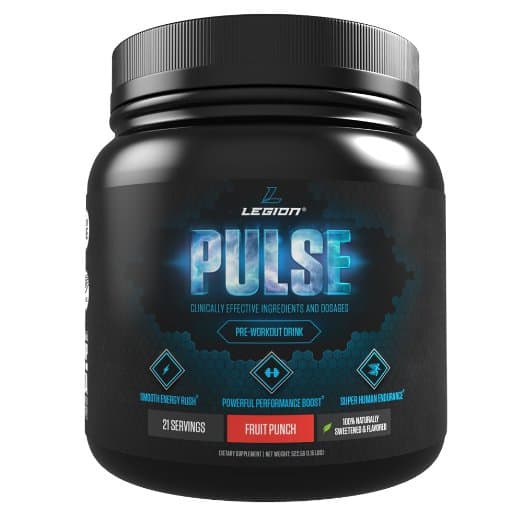
Pulse lists every ingredient and its amount on the label, with no proprietary blends. That makes it easy to compare the doses with the research.
It comes in several flavors. For this review, I tried Blue Raspberry.
Legion Pulse Pre-Workout Overview
Like other pre-workouts, Legion Pulse is marketed to boost focus, energy, and endurance.
Legion claims its doses are higher than those in other options. Several of its doses are high compared with many pre-workouts, but check each ingredient against the research below.
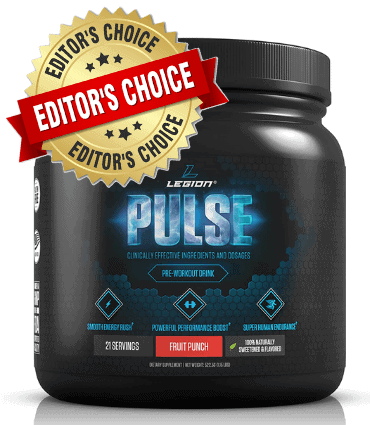
The label says Pulse is naturally sweetened and flavored, so it has no artificial sweeteners or dyes. An earlier label also listed it as gluten-free.
Pulse is high in caffeine, so it's best for people who already tolerate caffeine well. If you don't, there is a caffeine-free version, Pulse Stim-Free.
Pulse does not contain creatine, so take that separately if you use it.
Nutritional Profile & Ingredients
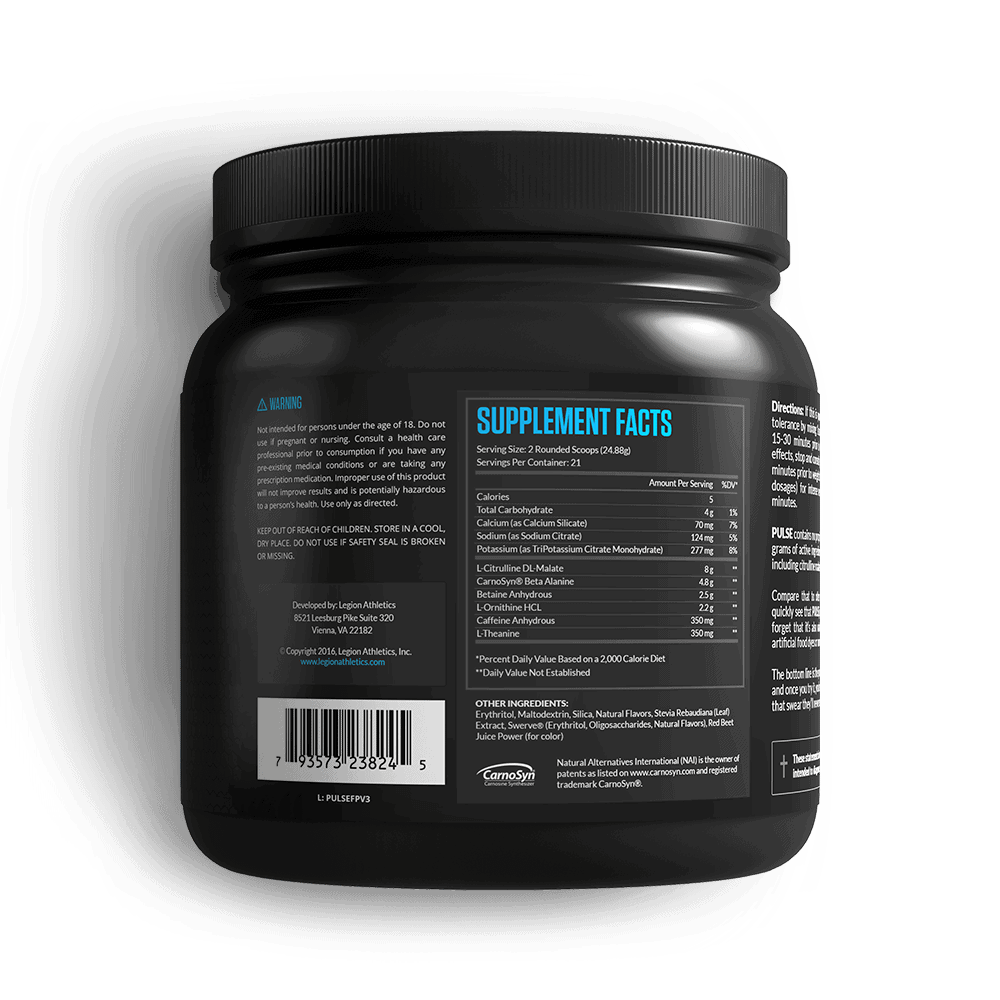
According to the label in the NIH Dietary Supplement Label Database, a full serving of Pulse is 2 scoops (about 23.5 g), and a tub holds 20 servings.
That full serving contains 350 mg of caffeine. For comparison, the FDA says a 12-ounce cup of brewed coffee usually has 113 to 247 mg.
Research supports caffeine doses of about 3 to 6 mg per kg of body weight, so 350 mg is at the high end for many people. If that's too strong, use 1 scoop or the stim-free version.

A full serving also contains:
- L-citrulline DL-malate: 8 g
- Beta-alanine: 3.6 g
- Betaine anhydrous: 2.5 g
- L-theanine: 350 mg
- Alpha-GPC: 300 mg
It also has some sodium and potassium. Older versions of this review listed L-ornithine and 4.8 g of beta-alanine, which current labels don't show.
Benefits & Effectiveness
Here is what the research says about the key ingredients.
Caffeine
Caffeine is the best-supported ingredient here for alertness and performance. At 350 mg, though, one full serving is close to the FDA's 400 mg a day limit for most healthy adults, before you count coffee, tea, or soda.
Too much caffeine can cause a racing heart, jitters, anxiety, upset stomach, and trouble sleeping. Pulse also pairs caffeine with L-theanine, which some people find smooths out the effect.
If you are caffeine-sensitive, train close to bedtime, or already drink a lot of coffee, there’s another version with no caffeine: Legion Pulse Stim-Free.
Beta Alanine
Beta-alanine raises muscle carnosine, which can improve performance in hard efforts lasting about 1 to 4 minutes.
The catch: it works by building up over time. The ISSN recommends 4 to 6 g a day for at least 2 to 4 weeks. A single pre-workout dose won't do much, so you'd need to take Pulse (3.6 g) daily for this benefit.
Beta-alanine also causes a tingling feeling on the skin. It's harmless and usually fades within about an hour.
L-Theanine
L-theanine is an amino acid found in tea. Some small studies suggest that taken with caffeine it may improve focus, but the evidence is limited.

Pulse has 350 mg of L-theanine, a 1:1 ratio with its caffeine.
It won't cancel out the effects of a high caffeine dose, especially if you are caffeine-sensitive or train later in the day.
Citrulline Malate
Citrulline malate combines the amino acid L-citrulline with malic acid. The body uses citrulline to make nitric oxide, which helps widen blood vessels.
Studies on performance and muscle soreness are mixed. Pulse's 8 g dose is in the range most studies used.
Alpha-GPC
Alpha-GPC is a source of choline, which the body uses to make the neurotransmitter acetylcholine. Evidence that it improves workout performance is limited. Pulse contains 300 mg.
Betaine
Betaine is found in foods like beets, spinach, and whole grains. Research on its effects on strength and power is mixed.
A study suggests it may need to be taken over days or weeks to have an effect. Pulse contains 2.5 g per serving, the amount most studies used.
Flavor & Taste
The taste of Legion Pulse mixed with water isn't bad, but it isn't the best either.
For a drink with no artificial flavors or sweeteners, the Blue Raspberry tastes a lot like raspberry candy.
Legion Pulse Side Effects
Most side effects come from the caffeine: jitters, a racing heart, anxiety, upset stomach, and poor sleep. If you get these, use 1 scoop or try the Stim-Free version.
Also, there is a tingly and sometimes itchy feeling from the beta-alanine. It is harmless.
The label says Pulse is not for anyone under 18 or anyone pregnant or nursing. Check with your doctor first if you have a heart condition or high blood pressure, or take prescription medicine.
Price
Pulse costs more per serving than many pre-workouts, and a tub holds 20 full servings. Prices change often, so check the current price.
If you use 1 scoop (a half serving) instead of 2, a tub lasts up to 40 workouts.
Legion Pulse Alternatives
Old School Vintage Blast
This pre-workout from Old School Labs costs about as much as Pulse.
If Pulse is too strong for you, Vintage Blast pre workouts may be a milder choice. Check its label for the caffeine amount.
Nitro Surge Pre-Workout
Nitro Surgeis a supplement from Jacked Factory that makes a more pocket-friendly alternative to Legion Pulse.
It usually costs less per serving than Pulse, and I preferred its taste.
However, it left a bitter aftertaste and made me thirsty. Drinking more water helped.
Pulse Pros and Cons Summary
Pros:
- Fully disclosed doses, no proprietary blends
- Citrulline malate and betaine at research-level doses
- Naturally sweetened and flavored
- No artificial sweeteners and food colouring
- Has a no-caffeine, stimulant-free option
Cons:
- Expensive
- Its caffeine content may be too high for some users. Try stim-free options instead.
- Beta-alanine causes tingling, and only helps if you take it daily
- 350 mg of caffeine per full serving is close to the FDA's 400 mg daily limit
Should You Get Legion Pulse?
All in all, Pulse is a well-labeled pre-workout with research-level doses of several ingredients. The caffeine does most of the work you'll notice.
It's a good choice if you want to avoid artificial sweeteners and flavors.
I like that it has a caffeine-free alternative because I tend to do my workouts in the evenings.
Nevertheless, the Legion Pulse pre-workout is a bit pricey...
…but you know exactly what you're getting.
Plus, you can use half a serving per workout. That doubles how long a tub lasts and keeps the caffeine at a more moderate 175 mg.
Sources
- Pulse Fruit Punch label, NIH Dietary Supplement Label Database
- Spilling the Beans: How Much Caffeine Is Too Much?, FDA
- International Society of Sports Nutrition Position Stand: Beta-Alanine, Journal of the International Society of Sports Nutrition (PMC)
- International Society of Sports Nutrition Position Stand: Caffeine and Exercise Performance, Journal of the International Society of Sports Nutrition (PMC)